How to Run a Fantasy Football League With an Odd Number of Teams
One way to run a fantasy football league with an odd number of people is to use Season DFS. It is a season-long fantasy football platform where every member builds a new salary-cap lineup each week instead of drafting and managing a permanent roster.
Season DFS supports odd membership counts in every standard game mode. A league can have 5, 7, 11, 23 (impressed with our knowledge of odd numbers?) or another odd number of members without asking someone to leave or recruiting an extra person just to make the schedule work.
The one exception is 32-team NFL mode.
That mode intentionally mirrors the NFL with exactly 32 teams, two conferences, and eight four-team divisions. Standard points, head-to-head, and all play leagues do not have that restriction.
Why Odd Numbers Cause Problems in Head-to-Head Leagues
An even number of teams divides cleanly into weekly pairs. A 10-team league has five matchups. A nine-team league can only make four direct matchups, leaving one team without an opponent.
Some fantasy platforms require an even team count for that reason. Others use a bye, an average score, or a commissioner-managed placeholder team. The draft itself is not necessarily the problem. The issue is how the weekly schedule turns an unmatched team's score into a fair result.
Season DFS handles that issue differently depending on the game mode. Commissioners do not need to create a fake team or manually calculate standings.
Points Leagues Do Not Need Weekly Opponents
Points is the simplest Season DFS option for an odd-sized group. Every member's weekly fantasy score is added to their season total. The team with the most points leads the standings.
Because there are no weekly pairs, the number of league members does not affect the format. Seven teams work the same way as eight. Nine work the same way as 10. Everyone submits a lineup, everyone adds to their season total, and nobody sits out.
Choose points if your group wants the most direct measure of performance across the season and does not need weekly wins and losses.
Head-to-Head Uses the League Average
Season DFS also supports an odd number of members in head-to-head. Most teams receive a scheduled opponent each week. The one unmatched team plays against the average score of every other league member.
For example, a nine-team league has four direct matchups. The ninth team is compared with the average of the other eight scores. If the average is 112.4 points and the unmatched team scores 118.7, that team earns a win. A score below 112.4 earns a loss, and an identical score results in a tie.
The unmatched team's own score is excluded from the average. Its result therefore cannot move the score it is trying to beat. The schedule rotates the league-average matchup among members rather than assigning it to the same team each week.
Odd-sized head-to-head leagues can also use fantasy football divisions with uneven team counts. For example, an 11-team league can split into divisions of six and five while the weekly league-average matchup rotates among all 11 teams.
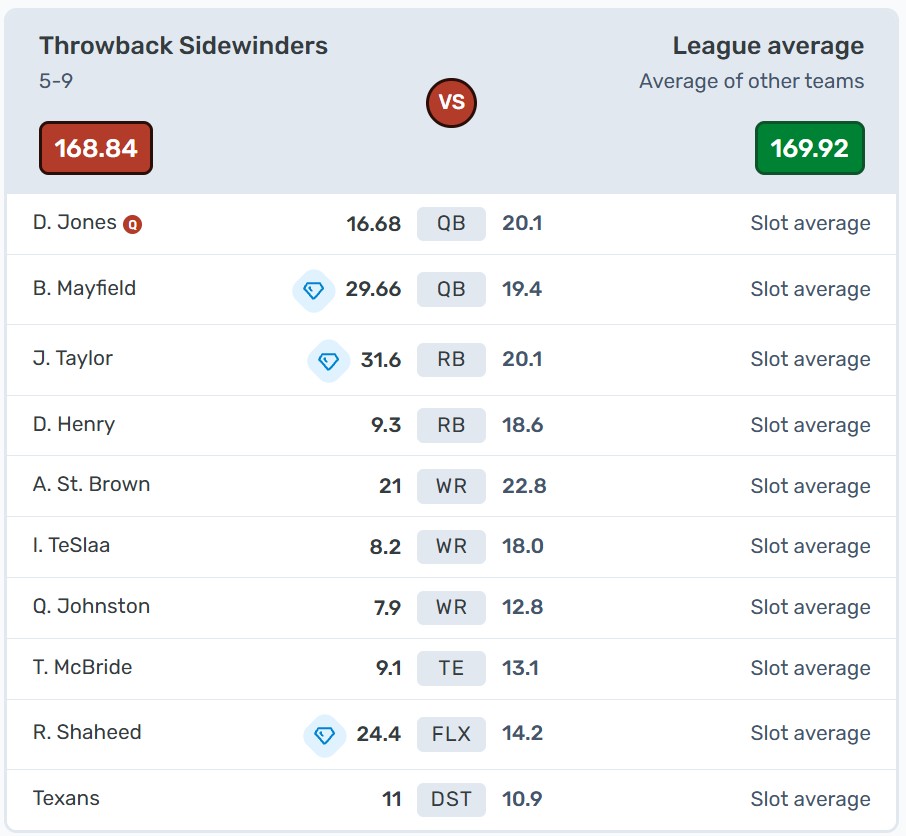
This gives every team one meaningful result every week. There are no automatic wins and no weeks that disappear from a team's record.
All Play Compares Everyone Each Week
All play does not use one-to-one weekly pairings, so odd numbers work naturally. Every lineup is compared with the rest of the league each week. Season DFS offers two all play standings styles.
- Placement points: Teams earn standings points based on how many league members they beat. The commissioner can also configure bonuses for the top weekly finishers.
- Win/loss record: Each team records a win, loss, or tie against every other member based on that week's scores.
In a nine-team league, the highest scorer beats eight teams. The second-highest scorer beats seven, and the comparisons continue through the standings. There is never an unmatched team because everybody plays against everybody.
Which Season DFS Game Mode Should You Use?
| Game mode | How odd numbers work | Best fit |
|---|---|---|
| Points | No weekly opponents are required | Simple season-long totals |
| Head-to-head | The unmatched team faces the league average | Weekly matchups and familiar records |
| All play | Every team is compared with the full league | Less schedule luck and more weekly comparisons |
| 32-team NFL mode | Odd numbers are not supported | Exactly 32 teams in an NFL-style structure |
Use points for the simplest setup. Choose head-to-head if your group wants one weekly result and direct opponents. Choose all play if you want every lineup measured against the full league and less influence from a random schedule.
Season-Long Fantasy Without a Draft
Season DFS is not a workaround for running a traditional redraft or dynasty league. There are no permanent rosters, trades, or waivers. Every member selects a new lineup from the available NFL players each week while staying in the same league and competing in season-long standings.
That distinction matters. If your group mainly wants to draft players and manage those rosters all season, use a traditional fantasy platform that supports your preferred odd-team scheduling rule. If your priority is keeping the whole group together without worrying about an even head count, Season DFS is one option built to do it.
Learn more about the weekly format in our guide to running a season-long DFS league, or compare the Season DFS game modes.
Keep the Odd Number
Create a Season DFS league for the group you already have. Choose points, head-to-head, or all play, then invite everyone without waiting for one more person to make the number even.
Create a League